If Cape Town is on your radar, but you are still sitting on the fence about whether you should buy now - you should perhaps not wait too long.

This is the word from Ian Slot, MD for Seeff Atlantic Seaboard and City Bowl, who says history has shown us that if one real estate market has bucked the trend, it is Cape Town.
“While it fluctuates, as any market does, you can draw a neat upward trend line when it comes to capital value appreciation and price growth,” he says.“Growth in property values have not just topped inflation, but has far outstripped the economic growth.”
The performance data for the Cape and the Atlantic Seaboard and City Bowl, in particular, shows that the market always bounces back strongly after every major shock. From rate increases and large currency devaluations to economic downturns, the water crisis and so on, there is a very clear trend that the Cape Town property market has kept on improving over time despite these factors and challenges.
Looking at the Atlantic Seaboard and City Bowl in particular, Slot says we see an acceleration in interest as the 1990s progressed. By 1998/9, the prime interest rate was at around 18.5% and economic growth at 2.5% on average, yet the average selling rate for the metro accelerated into double digits by the 2000s.
Over the next five years, the economic growth increased to around 5.5% while property prices in the Cape metro grew at 20% to 30%. Tourism began its boom and as more foreigners visited Cape Town, more people invested in second homes here, both for lifestyle and investment reasons. Johannesburgers and other wealthy upcountry buyers also began investing in prime Atlantic Seaboard areas such as Clifton and Camps Bay, says Slot.

Following the Global Economic Crisis (GEC) of 2008, the Cape Metro as with the rest of the country, experienced a slump in sales and price growth, but prices still held firmly. The 2010 Soccer World Cup was a major boost for Cape Town. Aside from the infrastructure development around the lower end of Green Point and Sea Point, it brought renewed interest in Cape Town property. It also boosted tourism and put the city on the global radar for visitors. Tourism marketing of the city and province further boosted its attraction to visitors and property investors.
From about 2012, the DA’s top class management of the city and province began attracting people from other parts of the country to the city, says Slot, which added further to the demand and at one point, Western Cape Premier, Helen Zille even remarked at how the majority of bonds granted in Gauteng were actually for Cape Town houses.
“While we have seen economic decline, especially under the Zuma-period, Cape Town and the Atlantic Seaboard and City Bowl prices, in particular, have continued rising at stellar rates,” says Slot.
This, he adds, was despite economic growth hovering around 2.5% and declining rapidly from 2013 to around 0.6% in 2017. A study published by FNB early last year showed that while average house prices in South Africa had gone nowhere since 2012, Atlantic Seaboard prices more than doubled since 2012 and increased sevenfold since 2001, ending 2017 on an average growth of 22.9%.

Slot notes the the study shows further that City Bowl prices rose by 590.95% over 15 years (2002-2017) and 113.28% over 5 years (2012-2017), averaging at 15% to 20% growth annually. Atlantic Seaboard prices grew by a stellar 734.58% over the 15-year period and 122.78% over 5 years with annual growth of 16% to 26%.
In the early 2000s, Ellerman House in Bantry Bay sold for over R20 million, a record price for the Atlantic Seaboard at the time. By 2009, Seeff sold the One&Only penthouse for the highest price for the area (and country) for residential property at well over R100 million.
By 2012, it was becoming commonplace for Clifton and Waterfront apartments to sell above R20 million ranging to R50 million-plus on the Front Yacht Basin. In 2014, Seeff again set a record price for a Bantry Bay apartment at R42.5 million and subsequently resold it early this year for another record price of R53.8 million.
Slot says in 2015, Seeff breached the R100 million price mark in Clifton with the sale of a luxury villa in Nettleton Road for R110 million to an SA buyer and so the list goes on.
He says where the top five suburbs of the Atlantic Seaboard - Clifton, Camps Bay, Fresnaye, Bantry Bay and the Waterfront - now easily command selling prices above R20 million, this has filtered through to the surrounding areas.
Mouille Point for example now attracts top-end buyers to its new beachfront developments and the ceiling price for a house in Green Point and Sea Point has lifted to over R10 million, as these areas are now seen as the next best thing to Fresnaye and Bantry Bay.
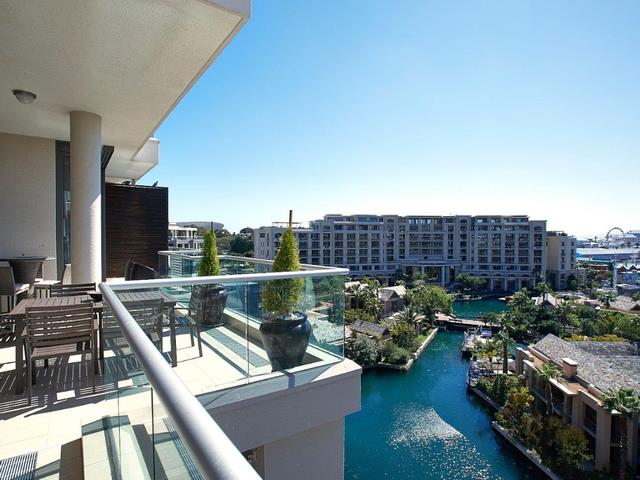
The DA management of the city, despite its recent challenges including the water-crisis, continues to give the city an edge over other metros, says Slot. So too, does its rise as an international tourist hotspot and ideal holiday and lifestyle proposition, which means that it is seen as a store of wealth for high net-worth individuals (HNWI).
As a sought-after tourist city, Cape Town now frequently ranks in international top ten or twenty listings, whether as a tourist destination, most beautiful city or for its luxury property achievements. It is hot property not just for locals, but Slot says that upcountry buyers and foreigners looking for second homes in Africa will continue to set their sights on Cape Town. This adds a premium of around 20% to the local market and up to 40% in the top-end Atlantic Seaboard suburbs.
Slot says while the market has slowed for a number of well-publicised reasons, it is always good to remember that the market is nowhere near dead, in fact, far from it. History shows that the market has bounced back from every downturn, emerging in a much stronger position.
Smart sellers will tell you that the property market rewards those that buy smart and with a long-term view, he says. The data shows that when the market turns south, might just be a good time to invest.