In only four months, 37 stands to a total value of more than R28 million have been registered or are in the process of being transferred at Romansbaai, the beach and fynbos estate in Danger Point near Hermanus on the Western Cape coast.

Of the entire offering, 80 houses will be built by the developers on a plot and plan basis, and the remaining 379 homes will be built by owners, according to a strict development guideline.
Developer David Mostert says the response from buyers has been remarkable and he believes it represents both a pent-up demand for fast-dwindling coastal living opportunities and an upswing in the residential property market.
He says although Romansbaai is not an average offering, and buyers are specifically attracted to its position and unique features, the immediate and enthusiastic response to its appeal does reflect partly on a more optimistic outlook in the residential property sector.
Among its attractions is Romansbaai’s likelihood of being the last coastal residential estate with direct access to a beach and the ocean.
The 220 hectare estate, 40 kilometres from Hermanus and 180 kilometres from Cape Town, is also one of a few maritime estates on the coast that face north. It has a view across Walker Bay to the Hottentots Holland Mountains.

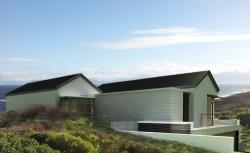
Indigenous plants and fynbos cover the entire landscape of the security resort, and buildings and roads are designed to blend into the vegetation and other natural features.
A further encouragement for buyers is the completion of services and roads and the security measures that include a gatehouse.
Mostert and his partners in a company named Cardinet, are responsible for bringing Romansbaai back to viability through the business rescue process, after the development faltered during the early days of the recession in 2008. One of the original landowners of Romansbaai, Mostert had placed the estate in Pinnacle Point, which went into liquidation in 2011. Subsequently, a business rescue was approved, and, with revised budgets and major financial injections by Mostert and his partners, the turnaround process for Romansbaai was put into effect.
One of the major assets of the estate was the R60 million already spent on infrastructure.
Of the entire offering, 80 houses will be built by the developers on a plot and plan basis, and the remaining 379 homes will be built by owners, according to a strict development guideline. A total of 27 stands are directly on the seafront, while the rest stretch into the fynbos reserve, with wide areas of vegetation between the groupings.
Security is a priority and the entire estate is monitored electronically within the low visual impact high-tensile steel mesh fence that surrounds it.
Although the development’s approval pre-dates the provisions of the new National Environmental Management Act related to oceanside projects, which are now severely restricted, Mostert says conservation on the site goes way beyond usual measures to preserve the natural environment.
Only 15 hectares of the 220 hectare site are being developed, and each stand, ranging in size from 1 200 to 6 400 square metres, has a restricted footprint for construction, and no private fences are permitted.
Indigenous plants and fynbos cover the entire landscape of the security resort, and buildings and roads are designed to blend into the vegetation and other natural features. The developers are spending around R500 000 a year on the eradication of alien plant species and, at the gatehouse precinct alone, over 7 000 new endemic indigenous plants have been introduced. Where plants had to be removed for roads and pathways, they were transferred to a nursery and then replanted on the site.
Mostert says the development touches its environment lightly, with no pathway or road reserve wider than three metres, and all services, including water and electricity, following within the road reserve to the various homesites. The development is linked directly to the local municipal services, which were upgraded specifically to accommodate Romansbaai in 2006.
Pedestrian, cycle and golf cart access to the beach is provided by a single dedicated road for exclusive use by residents of the estate and visitors to the 40-room hotel that will eventually be developed there. As with all the other roads on the estate, it is paved with an unobtrusive, aggregate-embedded material. There are no streetlights, and light emission from houses is also regulated.
Romansbaai is expected to contribute directly to the economy of the surrounding areas, in that it will provide a market for local traders, and employment for residents of the area, both in the construction phase of the houses and in the maintenance of the estate.
Mostert says one of the major objectives is to mitigate the decimation of natural resources including perlemoen by poachers. "Our conservation mission goes further than the land we occupy, and includes the ocean and the people too. Where poverty forces people to resort to illegal means to survive, we are committed to help alleviate their plight.”
He says as the estate’s population reaches a critical mass, they expect an improvement in the fortunes of disadvantaged locals, by way of full- and part-time work.
Security is a priority and the entire estate is monitored electronically within the low visual impact high-tensile steel mesh fence that surrounds it. Access via the gatehouse is by biometric identification devices and the entrance is manned by a security company that is already fully operational.
The majority of buyers have come from the Cape and Gauteng, and Mostert hopes that local residents from surrounding seaside villages will buy homes at Romansbaai, attracted by the safety features and the well-maintained environment. Stands are for sale from R495 000.
For more information, call David Cooke on 082 566 1238 or visit www.romansbaai.co.za.