Have you ever been envious of a particularly beautiful plant that you have seen in a friend’s garden, but you can’t seem to find it in any nursery?

Cloning your favourite plant from a cutting takes far less time than growing plants from seeds, and it costs next to nothing.
If this is the case, why not consider taking a cutting of this particular plant and growing one of your own.
Growing a plant from a cutting takes far less time than growing plants from seeds, it also costs next to nothing, and even though seeds can turn out looking entirely different form their parent plant, cuttings are always identical clones.
Choose which plant you want to grow from a cutting
Not all plants can grow from cuttings – trees are the most difficult, while plants with succulent stems, such as geraniums and cacti are the easiest.
You can take cuttings from plants with gorgeous flowers, such as daisies, begonias, chrysanthemums, frangipanis or pelargoniums for example.

You can clone cuttings from plants with gorgeous flowers, attractive foliage or even aromatic herbs.
Or your choice could be made because of the plant’s attractive foliage – such as abelia, ivy or plectranthus.
Herbs are another good option, as they can be used in the home and they smell nice – you can grow various herbs from cuttings, such as lemon balm, rosemary, mint, origanum, sage and thyme for example.
Your best bet would be to try various different plants out on a trial and error basis and see which are easy to propagate from cuttings.
How to grow the cuttings
Follow these simple steps to grow plants from cuttings:
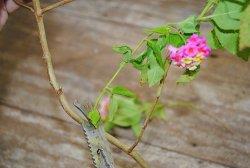
Make the cutting
1. Choose your container
You can use any adequately sized container – from terracotta, ceramic or plastic pots, to large empty yoghurt containers, old tins or the base of a two-litre PET bottle.
Make sure that whatever container you choose has a couple of small drainage holes in its base to allow water to drain out.
2. Fill the pots
For best results, a special planting mixture needs to be prepared – the mixture should comprise half vermiculite or finely-ground perlite (available from most hardware stores), and half sterilised potting soil.
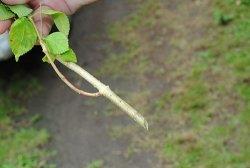
Trim the cutting
Fill each of your containers with this mixture.
3. Make a cutting
Once you have chosen which plant you want to take the cutting from, use sharp garden secateurs to snip off shoots from the plant.
Although softwood cuttings are the most difficult to keep alive, they do boast the best ability to produce roots.
As such, your best bet would be to take a cutting from the parent plant that has both reasonably new and mature growth. The cutting should be between 10cm and 15cm in length. It should be cut at a 30° diagonal angle, approximately 0,5cm to 1,5cm below a knot because roots grow around or underneath a knot. (A knot is the point in the stem where two small branches or leaves grow out of the stem.)
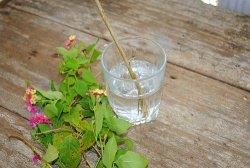
Treat the cutting
4. Trim the cutting
Remove any flowers that are on the cutting, as well as all the leaves, except for around two to four leaves located at the top of the cutting – this will reduce any unnecessary water and nutritional loss.
5. Treat the cutting
Let the cutting sit in a glass containing a mixture of liquid fertiliser and water for around three hours.
Then, dip the cutting into a hormone powder or liquid, preferably one that contains fungicide. (Be sure to wear gloves when you are dealing with this substance, and to wash your hands well afterwards.)
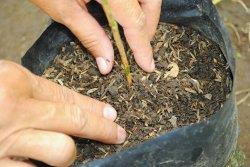
Plant the cutting
6. Plant the cutting
Use a pencil or pen to create a small hole in the potting soil mixture, and place the cutting into the hole so that the leaves of the cutting are just above the soil.
Then firm the soil around the cutting, and gently water it.
7. Keep the moisture in
It is essential to keep the cuttings well hydrated if they are going to take root.
The best way to do this is to cut a two-litre PET bottle in half, and place it like a dome over the cutting. Push it firmly into the soil surrounding the cutting – this will keep all the moisture inside. Keep the domed cutting in a spot with dappled shade.
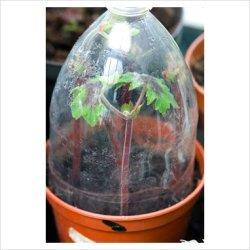
Keep the moisture in to start the growing proccess.
8. When it starts growing
A few weeks later, when new growth appears, you can remove the dome and place the container in a location with more sunlight.
Water and fertilise the cutting regularly, and once the roots have adequately developed, you can replant it directly into the garden. (You can tell when the plant has rooted if you feel resistance when you tug gently on the stem.) – Antonella Dési